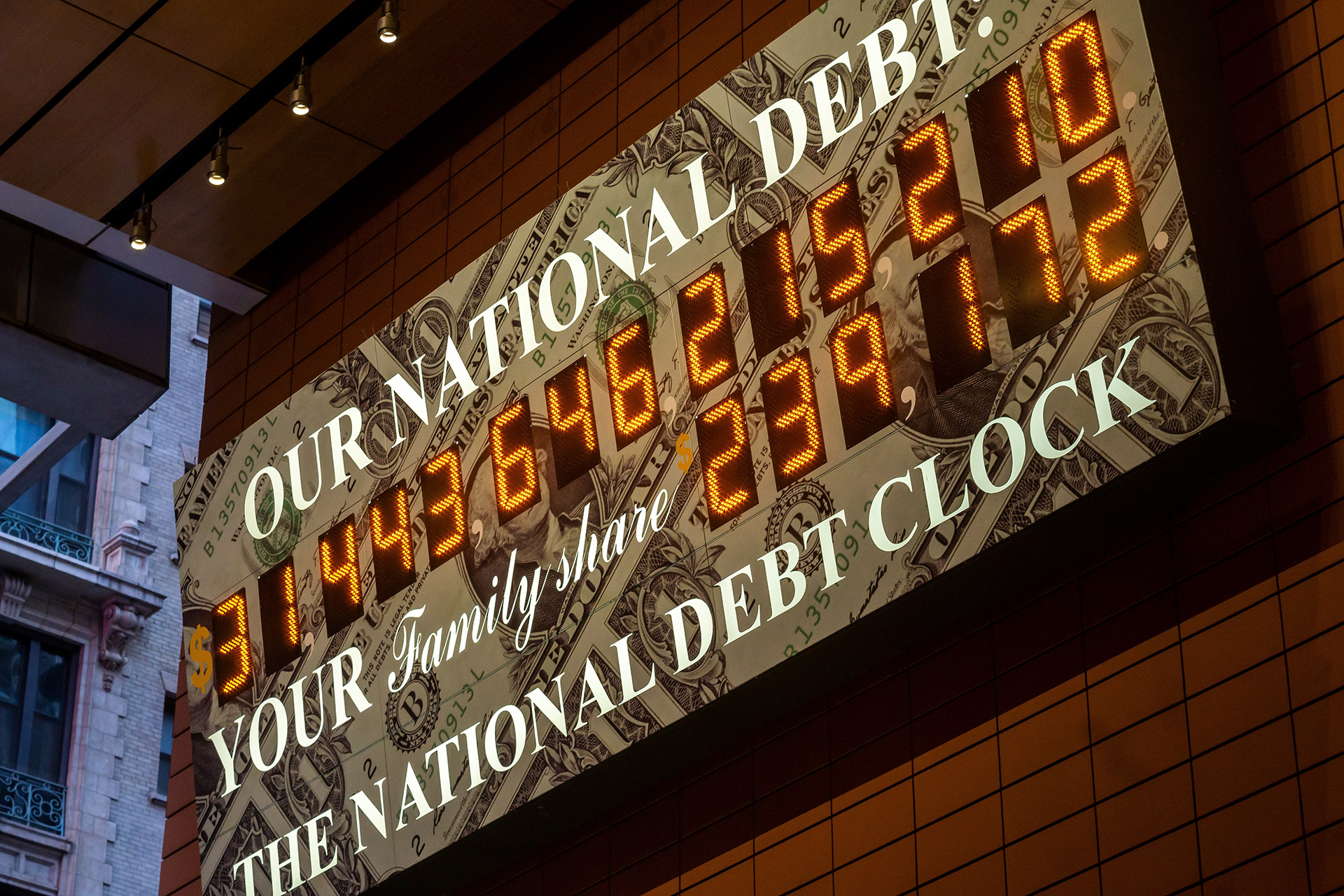
The history of money is as old as that of humankind. It took various forms before gradually evolving into a debt. This transition, which began in the middle ages, paved the way for the shift from a market economy to capitalism and a major societal change, during which a new relationship with time took hold. Human beings, driven by their fear of the future, felt the need to put a price on time. And in their desire to escape death, they saw the accumulation of money as a way to attain eternity.
Capitalism raises not only the moral issue of the act of commerce—namely, what is being sold, but also that of time. From its very inception, it imposes a rational framework on history. It could thus be defined as a dynamic economic system that is constantly and at all costs oriented toward the future. A system in which the sole focus is on exchange value rather than use value. In other words, a system where the product being sold is no longer a consideration, since the sole objective is to sell it—and thus to accumulate profit (surplus value, as Marx would say). Money becomes an end that justifies the means.
Born in an era when the influence of Christianity was waning, capitalism subsequently developed along various lines, notably through Protestantism. In The Protestant Ethic and the Spirit of Capitalism, Max Weber explains that Protestant morality played a decisive role in the formation of capitalism, insofar as the Reformation made wealth a divine blessing. According to him, the pursuit of profit must be “constantly renewed” because, for Protestants, the “duty of avarice” is the idea that it is everyone’s duty to increase their capital, which is supposed to be an end in itself.
But this conception clearly shows that the Reformation was merely a step along the path of capitalism, which had begun three centuries earlier. If capitalism had been born in 1517, at the dawn of Protestantism, Germany and the United Provinces – which were then dominant in Europe and the world – would have been at the origin of this new financial economy. However, as Fernand Braudel points out in The Dynamics of Capitalism, the northern countries “merely took the place long and brilliantly occupied before them by the old capitalist centers of the Mediterranean. They invented nothing, neither in technology nor in the conduct of business. Amsterdam copied Venice.”
The triptych that Weber establishes between wealth, work, and the divine remains, however, distinctly that of capitalism, even though evidence of this worldview predates the Protestant ethic. The essence of capitalism is a new conception of time: it stems from the anthropological rupture of the latter part of the Middle Ages, when the mercantile conception of time ultimately came to dominate. In 13th-century Italian thought, the afterlife does not exist, time is not eternal, and the economy serves as the engine of historical progress. The two leading figures of Protestantism, Calvin and Luther, speak of the afterlife as an abstract concept that offers no concrete answers. Indeed, doubt is one of the necessary conditions for capitalism.
If time is not infinite and life on Earth is the only true one, human interpretation ultimately prevails. The commodification of time becomes possible, since it is no longer imperative to submit to the timeless. Although he made Protestant ethics a fundamental condition of capitalism, Weber was certainly not unaware of all this, since he repeatedly emphasizes that Protestantism and the spirit of capitalism are themselves part of a new relationship to time inherited over several centuries.
This acceptance, however, has given way to transgression. Centuries after this anthropological shift, within this materialist continuum, doubt – inherent in capitalism – has now been replaced by amnesia, which leads to the abandonment of all limits. And capitalism continues to expand, elevating the power of money to the status of God, even to the point of seeking to replace Him. Since the late nineteenth century, the words “In God We Trust” have appeared on the front of every one-dollar bill.
Salvation and success are no longer to be found in justice or truth, but in the accumulation of money.
The debt economy has thus assumed divine dimensions, going so far as to create its own space-time by accelerating the order of things. Since debt allows us to produce today what could be produced later, it creates a distortion and acceleration of time, turning the race to accumulate capital into a race against time. The greater the volume of debt, the more time is compressed and history accelerates. Do sociologists not constantly speak about the Great Acceleration?
This economic system disrupts everyone’s rhythm and encourages people to work always harder to pay off their loans. This system takes hold even at a very young age: college education is very often financed through loans, as in the United States, where nearly 60% of students carry an average debt of about $30,000. It is no coincidence that the most attractive sectors are the most profitable… Ultimately, the creditor appropriates the debtor’s time and exploits it to the point of dictating the debtor’s own decisions. In the case of private debt, this applies to the individual in debt. In the case of public debt, it applies to the state and society as a whole.
As soon as a debt is issued, it requires growth and the revenue necessary to pay its interest. In the modern economy, where money and debt are one and the same, growth is therefore a necessity for an individual, a business, or a government to ensure its survival for as long as possible and to avoid excessive debt that could lead to bankruptcy or default. This growth then leads to an abundance of needs and goods that entertain those who use them and further distort their perception of time. Time is constantly compressed, particularly in the places and sectors where debt is most widely used. In the financial sector, for example, whose primary function is the exchange of debt, time is measured in milliseconds, or even nanoseconds.
The gradual introduction of our debt-based currency also leads to widespread impoverishment through inflation. Simply because the money supply exceeds the economy’s output due to a growing accumulation of debt, it loses value over the years. In addition to temporary inflation linked to external factors (epidemics, social tensions, trade threats, etc.) or larger-scale events (wars, regime collapses, etc.) that lead to significant money creation, there is also permanent inflation linked to the depreciation of the currency.
Nowadays, every unit of currency exchanged is a debt. And all wealth held in a bank account is an acknowledgment of the bank’s debt to its customer – that is, a future value. Once “minted” by the government, currency is now essentially under the control of private companies, specifically, banks, which create it “out of thin air” like alchemists, through a simple accounting entry, while holding, in equity capital, only a tiny fraction of the amount lent.
This historical development has led capitalism, in its most advanced form, to abandon the gold standard in 1971, thereby separating money creation from any physical constraints. With global debt now reaching 346,000 billion dollars and the future more precarious than ever, this system is gradually leading us toward a massive collapse. To prevent such a crisis from occurring, a major monetary jubilee, freeing nations from these chains, must be implemented as soon as possible, to pave the way for the creation of a prosperous and balanced economic system.